Sept 11, 2021 - terrorists' attack at WTC New York
September 11, 2026, 25 years later
My Memories of September 11, 2001
On September 11, 2001, I was in Wisconsin. At that time—since the early 1980s—I had been volunteering in species conservation outside of my main profession (chemist, researcher, innovative entrepreneur) without holding any official position, and since 1995 I had been developing a specialized bioacoustic technique (which I devised myself) in Germany (at Duvenstedter Brook near Hamburg) for a specific type of behavioral and cognitive research on cranes. This led to an invitation for me to contribute my technique to a massive project to save the whooping cranes, of which there were still only about 160 wild individuals at the time. The goal was to train young cranes raised in isolation to fly behind ultralight aircraft in order to learn the migration route from Wisconsin to Florida. This would allow us to establish a new, additional population in Wisconsin over the years. We had practiced this in previous years with sandhill cranes. Without my technique, the young cranes did not become wild after the flight but were imprinted on humans. With my technique, it worked: the young cranes became accustomed to the aircraft very quickly, showed no imprinting on humans, and remained wild. This had been demonstrated in the fall/winter of 2000 with a final test release of whooping cranes (juveniles).
So the decision was made for 2001: the first group of juvenile sandhill cranes would be trained. This took place after breeding and rearing (at two institutions in the U.S.) at a wildlife refuge in Wisconsin. I was there as a trainer for the caretakers, flight trainers, and pilots, because I taught the team how to use my hardware and software to guide the cranes on the one hand, and to prevent them from becoming imprinted on humans on the other.
One day—September 11—I had to take one of the megaphones that was part of the hardware to a UPS station about 50 km away to send it to Germany for repair. On the way, as I always did in the U.S., I had tuned in to National Public Radio: classical music and news. Suddenly, there was an interruption: a plane had crashed into one of the towers of the World Trade Center. Chaos. Uncertainty. I immediately tried to find a town with a payphone (in 2001, I didn’t have a cell phone with which I could have called Germany directly—that wasn’t possible back then).
I called my financial advisor, who managed the investments made with the capital contributions for my new chemical company (essentially a startup). He described to me what he was seeing on TV: right in the middle of my call, the second plane crashed into the second tower. The value of my investments plummeted by the second. My company was, to the minute, teetering on the brink of bankruptcy. We discussed a few countermeasures—not many, but at least a little helpful.
I took the megaphone to UPS, drove the long way back to the wildlife refuge, and told my American and Canadian project partners what they hadn’t witnessed. They rushed to their RVs—which we’d each left there for the duration of the flight training—and watched the disaster unfold on TV.
At the same time, it was clear: there was a U.S.-wide flight ban. That meant two things:
– my return flight, booked for three days later, was canceled;
– we wouldn’t have been allowed to continue flying the ultralight aircraft or continue training with the cranes; the project leaders decided: “We’re going to keep flying—let them figure it out for themselves!” (Air traffic control didn’t notice.)
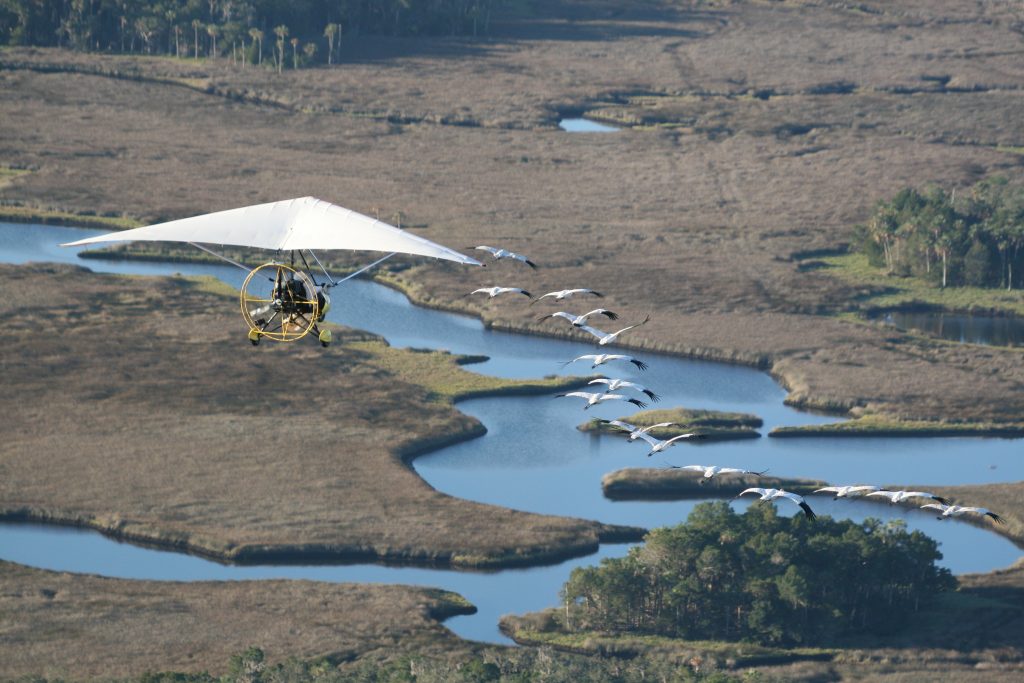
The project went ahead; at the end of October, the flight to Florida took off and marked the first step toward complete success. The photo shows the whooping cranes following the ultralight aircraft; it was taken from another ultralight flying slightly higher and behind it. For 15 years, using my artificial communication technique—based on the original vocalizations of wild whooping cranes that I had collected during several expeditions in previous years—I repeatedly released newly reared young birds into the wild and trained them to follow the ULFs. A new population now breeds in Wisconsin and winters in Florida. There are now just over 700 wild whooping cranes in three populations: the original one in northern Canada (which winters in Texas), the one in Wisconsin/Florida, and a non-migratory population in central Florida.
After 9/11, I had tremendous trouble organizing a return flight; I finally set out a week later in a small plane to the Canadian border, crossed the border on foot, had a taxi waiting for me there, took it to a regional airport, and flew from there to Toronto and then home.
It took me almost three years to climb back out of the abyss of bankruptcy and return to a stable financial situation. In my book *The Call of the Cranes* and also in *What a Coincidence*, I recount this phase of my life.
There’s another curious detail: While I was stuck in Wisconsin, I received an invitation from then-Chancellor Gerhard Schröder to accompany him on his trip to China. This was related to my (previously unsuccessful) attempts to establish a joint venture in China, which had failed due to unacceptable demands from the Jilin provincial government—a matter I had reported to the federal government in a letter. At first, I had no desire to travel to China in November, given the situation where my company was on the verge of bankruptcy, but I ended up going anyway. I recount this in my book *Mein Sprung ins kalte Wasser* (only German, but cf. *Here they call me ‚LaoWei‘* describing the first 5 of my 13 years in China), because this episode in China was not the end of the story.
Meine Erinnerungen an den 11. September 2001
Am 11. September 2001 war ich in Wisconsin. Ich war damals – seit Anfang der 1980er – außerhalb meines Hauptberufs (Chemiker, Forscher, innovativer Unternehmer) ehrenamtlich ohne Amt im Artenschutz engagiert und hatte seit 1995 in Deutschland (bei Hamburg im Duvenstedter Brook) eine spezielle (von mir entwickelte) bioakustische Technik für eine besondere Art von Verhaltens- und Kognitionsforschung an Kranichen entwickelt. Das führte dazu, dass man mich eingeladen hatte, mit meiner Technik am riesengroßen Projekt zur Rettung der Schreikraniche, von denen es damals noch so etwa 160 wild lebende Exemplare gab, mitzuwirken. Es ging darum, in Isolation aufgezogene Jungkraniche zu trainieren, hinter Ultraleichtflugzeugen hinterherzufliegen, um den Zugweg von Wisconsin nach Florida kennenzulernen. Dann könnte man über die Jahre hinweg eine neue zusätzliche Population in Wisconsin aufbauen. Wir hatten das in den Jahren zuvor mit Kanadakranichen geübt. Ohne meine Technik wurden die Jungkraniche nach dem Flug nicht wild, sondern waren auf Menschen geprägt. Mit meiner Technik funktionierte es: Sehr schnelle Gewöhnung der Jungkraniche ans Flugzeug, keinerlei Prägung auf Menschen, sie waren und wurden wild. Das hatte sich im Herbst / Winter 2000 mit einer letzten Test-Auswilderung von Kanadakranichen (Jungvögel) gezeigt.
Also wurde für 2001 entschieden: die erste Truppe von Schreikranichen-Jungvögeln wird trainiert. Das geschah nach der Brut und dem Aufwuchs (in 2 Institutionen in den USA) in einem Wildlife Refuge in Wisconsin. Ich war als Trainer der Betreuer und Flugtrainer und Piloten dabei, denn ich schulte das Team, wie sie mit meiner Hard- und Software umgehen mussten, um die Kraniche einerseits zu leiten, andererseits nicht auf Menschen zu prägen.
An einem Tag, dem 11. 9., musste ich eins der Megaphone, die zur Hardware gehörten, zu einer gut 50 km entfernten UPS-Station bringen, um sie nach Deutschland zur Reparatur zu schicken. Auf dem Weg hatte ich, wie immer in den USA, den Radiosender National Public Radio angestellt: Klassik + Nachrichten. Plötzlich gab es eine Unterbrechung: 1 Flugzeug war in einen Turm des World Trade Centers geflogen. Chaos. Unwissen. Sofort versuchte ich, ein Dorf zu finden mit einem öffentlichen Telefon (2001, ich hatte kein Handy, mit dem ich direkt nach D hätte telefonieren können, das ging damals noch nicht).
Ich rief meinen Anlageberater an, der die mit den Kapitaleinzahlungen gemachten Anlagen für mein neues Chemieunternehmen (quasi ein Startup) verwaltete. Er beschrieb mir, was er im Fernsehen sah: genau während meines Anrufs flog das 2. Flugzeug in den 2. Turm. Die Kurse meiner Kapitalanlagen gingen in Sekundenschritten in den Keller. Ich stand mit meinem Unternehmen minutengenau direkt am Abgrund zum Konkurs. Wir besprachen einige wenig, aber immerhin ein bißchen hilfreiche Gegenmaßnahmen.
Ich brachte das Megaphon zu UPS, fuhr die lange Strecke zurück ins Wildlife Refuge und erzählte meinen amerikanischen und kanadischen Projektpartnern, was sie nicht mitbekommen hatten. Sie stürzten in ihre Campingwagen, die wir jeweils dort hatten für die Zeit, und sahen im TV die Katastrophe.
Zugleich war klar: Es gibt ein US-weites Flugverbot. Das bedeutete zweierlei:
– mein für 3 Tage später gebuchter Rückflug war storniert;
– wir hätten mit den Ultraleichtflugzeugen nicht weiter fliegen, nicht weiter mit den Kranichen trainieren dürfen; die Projektleiter entschieden: „Wir fliegen weiter, sollen sie das doch erstmal merken!“ (Die Flugsicherung bemerkte es nicht.)
Das Projekt wurde durchgezogen, Ende Oktober startete der Flug nach Florida und war der erste Schritt für einen vollen Erfolg. Das Foto zeigt, wie die Schreikraniche dem ULF folgen, das Foto wurde von einem dahinter und etwas höher fliegenden ULF aus gemacht. 15 Jahre lang wurden mit meiner Technik der künstlichen Kommunikation, basierend auf Original-Lautäußerungen wilder Schreikraniche, die ich in mehrere Expeditionen in der Jahren zuvor hatte sammeln können, immer wieder neu aufgezogene Jungvögel ausgewildert und trainiert, den ULFs zu folgen. Inzwischen brütet eine neue Population in Wisconsin und überwintert in Florida. Es gibt nun etwas mehr als 700 wild lebende Schreikraniche in 3 Populationen, neben der ursprünglichen in Nord-Kanada (Überwinterung in Texas), die in Wisconsin / Florida und 1 nicht ziehende Population in Znetral-Florida.
Nach dem 11. 9. hatte ich irre Probleme, mir einen Rückflug zu organisieren, begann ihn 1 Woche später mit einem Kleinflugzeug an die kanadische Grenze, ging zu Fuß über die Grenze, hatte dort ein Taxi hinbestellt, fuhr damit zu einem Regionalflughafen, von dort nach Toronto und nach Hause.
Ich habe fast 3 Jahre gebraucht, um vom Abgrund in den Konkurs wieder in stabile Verhältnisse zu gelangen. In meinem Buch „Der Ruf der Kraniche“ und auch in „Was für ein Zufall“ erzähle ich von dieser Phase meines Lebens.
Hinzu kommt noch eine weitere Kuriosität: Während der Zeit, in der ich in Wisconsin feststeckte, erhielt ich eine Einladung des damaligen Bundeskanzlers Gerhard Schröder, ihn auf seiner Reise nach China zu begleiten. Das hatte mit meinen (zuvor fehlgeschlagenenen) Versuchen zu tun, in China ein Joint Venture zu gründen, es scheiterte an nicht akzeptablen Forderungen der Provinzregierung Jilin, wovon ich der Bundesregierung in einem Brief berichtet hatte. Ich hatte zunächst keine Neigung, in der konkursnahen Situation im November nach China zu reisen, tat es dann aber doch. Davon erzähle ich in meinem Buch „Mein Sprung ins kalte Wasser“, denn bei dieser China-Episode ist es nicht geblieben.